Grow Back Augusta: Designing for New Beginnings
Product Designer | April-May 2026 | Figma, Blender, Vite React | 2 Developers, 1 Co-Designer, 1 Project Manager
Designing a augmented reality application created to help homeowners in Augusta reimagine and rebuild their backyards after the destruction of Hurricane Helene.
Overview
A Way to Rebuild Augusta, One Tree at a Time
In the aftermath of Hurricane Helene, Augusta residents faced the challenge of rebuilding their damaged landscapes. Created in partnership with UGA’s Archway Partnership, Grow Back Augusta is a mobile augmented reality application designed to help homeowners reimagine and restore their outdoor spaces.
The Impact
Grow Back Augusta allows homeowners to visualize their dream backyards by simply pointing their phones at an outdoor space. Developed as a New Media Certificate capstone project, our work was handed off for further development and showcased at university exhibitions, earning recognition in published articles.

Problem
Reimagining What Was Lost
In late 2024, South Georgia was hit hard by Hurricane Helene, a Category 4 hurricane that destroyed much of the area’s vegetation and forestation. Many Augusta residents were left with severely damaged landscapes, making it difficult to envision how to rebuild their outdoor spaces.
Between tree ordinances, insurance policies, and even basic botany knowledge, reforestation can seem a daunting task to someone just trying to relandscape their yard. The Grow Back Augusta Project was created to bridge that gap by providing an intuitive, accessible tool that could help users preview landscaping options directly on their property.

Research
Understanding What It Takes to Rebuild
Goal & Audience
Our goal was to understand the challenges Augusta homeowners faced after Hurricane Helene and explore how augmented reality could support their recovery. Through competitive analysis, homeowner interviews, and field research, we identified opportunities to make reforestation more accessible.
User Interviews — Hearing from Homeowners
I developed interview questions for two Augusta homeowners affected by Hurricane Helene. Their experiences highlighted three key insights:
01 Safety
Tree placement raised concerns about shade and falling branches.
02 Restoratation
Homeowners valued replacing trees lost to the hurricane.
03 Accessibility
Many users are unfamiliar with augmented reality, highlighting the need for clear onboarding

Competitive Analysis — Learning from Existing AR Experiences
I led the UX competitive analysis of applications like Green Schoolyards and WWF Forests, identifying familiar interaction patterns and gathering design inspiration into a moodboard in Figma. Meanwhile, our development team explored technical limitations, including iOS compatibility.

Green Schoolyards

WWF Forests

Moodboard in Figma
Field Research — Bringing Trees into AR
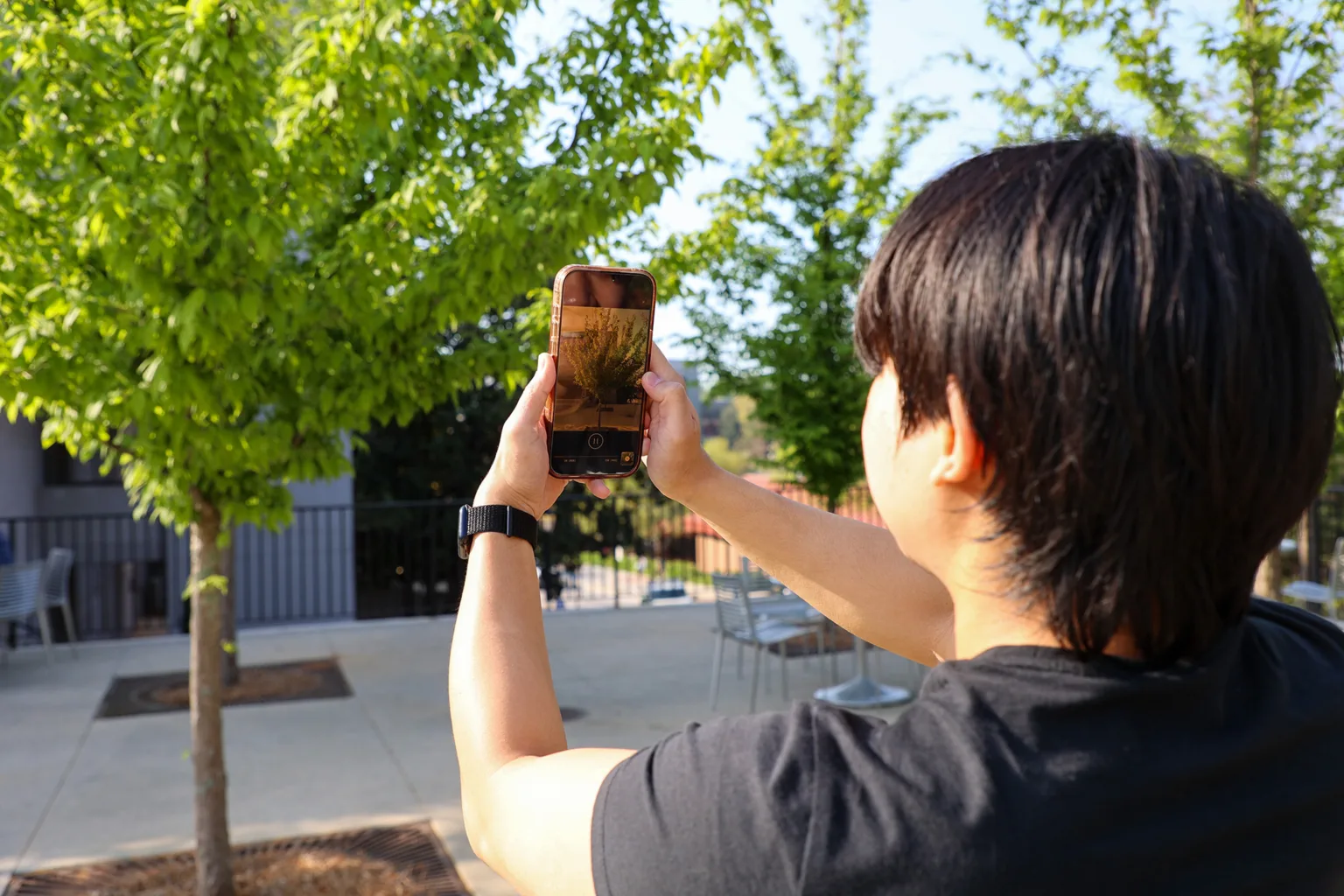
Our development team used Polycam scanning technology to capture real-world trees as 3D models for the application.

Empathy
Understanding the Users
Using insights from our research, I created two user personas to better understand and advocate for Augusta homeowners. One emphasized empathy through storytelling, while the other prioritized scannability to help guide development decisions.


Ideation
Making the Complex Feel Simple
My co-designer and I developed separate wireframes before combining our strongest ideas into a shared direction. Prioritizing simplicity and accessibility, I minimized the number of screens and introduced a familiar, card-based layout to help users navigate the AR experience with confidence.
I then translated the sketches into low-fidelity Figma wireframes to communicate user flows and key interactions to the development team.
I prioritized simplifying navigation and making tree selection more intuitive. I introduced a visual tree catalog, replacing the need to cycle through species individually, and designed information pages highlighting tree size, species, and growing conditions to support informed decisions.

The Solution
From Concept to Canopy
Branding
Using the UGA Archway Partnership’s established style guide, I incorporated Grow Back Augusta’s branding into the final designs, creating a cohesive visual identity that reflected the project’s environmental mission.


Prototyping
Our development team brought our designs to life in a functional mobile web application, allowing homeowners to explore tree species and visualize new landscaping possibilities directly in their own backyards.
From initial sketches to an interactive AR experience, Grow Back Augusta transformed our research and design decisions into a tool for rebuilding with confidence.
Reflection
Rebuilding Augusta and Beyond
The final product successfully delivers an accessible, web-based AR experience to homeowners, supporting all ranges of functionality and expertise. By offering multiple interaction modes, the app accommodates a wider range of devices and user needs.
From initial sketches to an interactive AR experience, Grow Back Augusta transformed our research and design decisions into a tool for rebuilding with confidence.
Beyond the Screen
Presenting The Grow Back Project
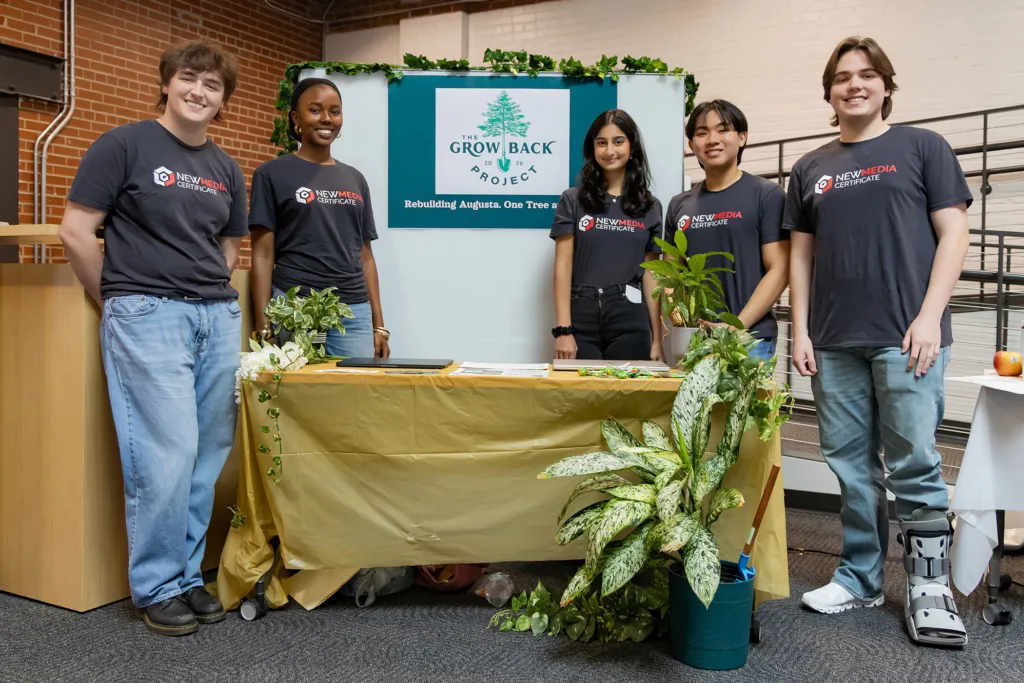
Team Grow Back Augusta presented our project at the New Media Institute's Demo Day and later to 80+ industry professionals at the New Media Institute SLAM Exposition.
I opened the presentation, and guided the audience through our journey from research to final prototype, highlighting how our mission, user insights, and design principles informed every decision. It was a great opportunity to communicate not just what we built, but why we built it that way.
Our team was also honored to be featured in various articles covering our work. Search "Grow Back Augusta Project" to read more!